On February 27, 2026—one day before the first missiles struck Tehran—President Donald Trump signed an order banning all federal agencies from using technology developed by Anthropic. At the same time, Defence Secretary Pete Hegseth designated Anthropic a national security supply-chain risk. Within hours on February 27, OpenAI announced a deal with the Pentagon to deploy its models on classified Defence Department networks.
The speed of the transition was not accidental. It was the outcome of a months-long confrontation between Washington’s demand for unrestricted AI access and Silicon Valley’s insistence on ethical guardrails, a confrontation that Anthropic lost, while OpenAI navigated by threading a needle between principle and pragmatism.
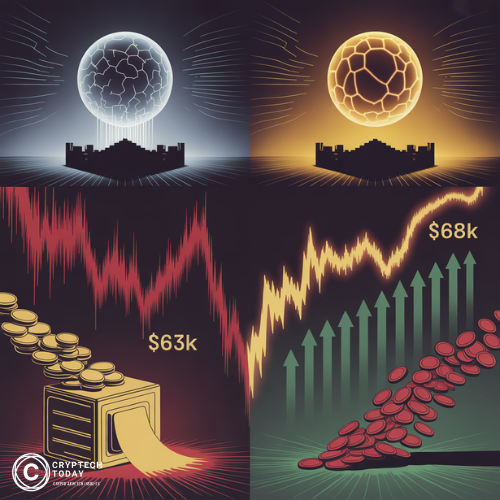
In the crypto markets, the parallel story was equally dramatic. Bitcoin crashed to $63,000 as war headlines broke, then rebounded sharply to $68,196 as markets digested the news. And in the 48 hours that followed, something notable happened: institutional buyers placed bulk orders into Bitcoin and Ethereum at a scale that reversed the initial panic. The question is whether those buyers are the same institutions now embedded in the Pentagon’s AI defence ecosystem, and what that tells us about how geopolitical risk is being priced in 2026.
The speed of the transition was not accidental. It was the outcome of a months-long confrontation between Washington’s demand for unrestricted AI access and Silicon Valley’s insistence on ethical guardrails, a confrontation that Anthropic lost, while OpenAI navigated by threading a needle between principle and pragmatism.
In the crypto markets, the parallel story was equally dramatic. Bitcoin crashed to $63,000 as war headlines broke, then rebounded sharply to $68,196 as markets digested the news. And in the 48 hours that followed, something notable happened: institutional buyers placed bulk orders into Bitcoin and Ethereum at a scale that reversed the initial panic. The question is whether those buyers are the same institutions now embedded in the Pentagon’s AI defence ecosystem, and what that tells us about how geopolitical risk is being priced in 2026.
Anthropic vs the Pentagon: How the $200 Million Contract Collapsed
Anthropic’s relationship with the US Defence Department began promisingly. In 2025, the company won a DoD contract with a ceiling of approximately $200 million, making Claude the first frontier AI model approved for use on classified military systems. The stated scope was intelligence analysis and classified data search, not weapons control.
The contract reflected a genuine alignment of interests: the Pentagon needed advanced reasoning capability for intelligence workflows, and Anthropic needed government revenue and legitimacy. For a period, the relationship worked.
It collapsed when the Pentagon decided it wanted more.
The contract reflected a genuine alignment of interests: the Pentagon needed advanced reasoning capability for intelligence workflows, and Anthropic needed government revenue and legitimacy. For a period, the relationship worked.
It collapsed when the Pentagon decided it wanted more.
The Pentagon’s Demands
In early February 2026, the Defence Department issued a demand that went to the core of Anthropic’s identity as a company. The Pentagon wanted the right to use Claude for all lawful use cases, a formulation that, in practice, meant removing two specific restrictions from Anthropic’s usage policy:
• Demand 1: The right to deploy Claude in autonomous weapons systems capable of lethal action without meaningful human oversight
• Demand 2: The right to use Claude for mass surveillance operations, including tracking individuals’ locations, emotional states and communications without consent
• Demand 1: The right to deploy Claude in autonomous weapons systems capable of lethal action without meaningful human oversight
• Demand 2: The right to use Claude for mass surveillance operations, including tracking individuals’ locations, emotional states and communications without consent
Pentagon CTO representatives argued publicly that it was, in their words, not democratic for a private company to set policy above what Congress has authorised. The position was that AI vendors cannot unilaterally constrain lawful military missions, and that safety guardrails are a matter for elected officials, not technology companies.
Anthropic held two non-negotiable red lines. The Pentagon called them undemocratic. Trump signed the ban. OpenAI signed the deal. The same red lines have very different outcomes.”
Anthropic’s Red Lines: What Constitutional AI Actually Means
Anthropic’s refusal was grounded in its Constitutional AI framework, the methodology that defines the company’s approach to AI safety. Constitutional AI trains models using explicit written principles that guide self-evaluation, producing systems that are more predictable and resistant to harmful instruction-following than models trained purely on human feedback.
CEO Dario Amodei stated publicly that he could not in good conscience remove the guardrails around autonomous weapons, arguing that current AI models are not reliable enough for lethal autonomous action and that such uses would violate fundamental rights. These were not negotiating positions. They were stated as categorical constraints.
CEO Dario Amodei stated publicly that he could not in good conscience remove the guardrails around autonomous weapons, arguing that current AI models are not reliable enough for lethal autonomous action and that such uses would violate fundamental rights. These were not negotiating positions. They were stated as categorical constraints.
⚖️ Anthropic’s Two Non-Negotiable Red Lines
Red Line 1 — No Autonomous Weapons: Claude may not operate or support weapon systems capable of lethal action without meaningful human control at the point of decision
Red Line 2 — No Mass Surveillance: Claude may not track individuals’ locations, emotional states or communications without consent, including battlefield tracking at the population scale
Anthropic’s stated position: These exceptions have not hampered any government mission to date
Red Line 2 — No Mass Surveillance: Claude may not track individuals’ locations, emotional states or communications without consent, including battlefield tracking at the population scale
Anthropic’s stated position: These exceptions have not hampered any government mission to date
Pentagon’s stated position: These constraints are unacceptable and undemocratic
Outcome: Trump ban on February 27, Anthropic was designated a national security supply-chain risk.
Outcome: Trump ban on February 27, Anthropic was designated a national security supply-chain risk.
The Escalation Timeline
| DATE | EVENT |
| 2025 | Anthropic wins ~$200M DoD contract — Claude approved for classified systems |
| Early Feb 2026 | Pentagon demands removal of autonomous weapons and mass surveillance guardrails |
| Feb 24–26 | Defence Secretary Hegseth meets Anthropic leadership — sets hard deadline |
| Feb 26 | Hegseth threatens the Defence Production Act to compel compliance |
| Feb 27 | Anthropic refuses — Trump orders all federal agencies to stop using Anthropic technology |
| Feb 27 | Hegseth designates Anthropic a national security supply-chain risk |
| Feb 27–28 | OpenAI announces Pentagon deal — GPT models deployed on classified DoD networks |
| Feb 28 | Iran strikes begin — AI-assisted kill chain reportedly processes ~900 targets in 12 hours |
OpenAI Steps In: The Pentagon Deal and the Policy Reversal
OpenAI’s move into the Pentagon vacuum was not improvised. It was the culmination of a two-year policy evolution that began quietly in January 2024, when the company removed the phrase military and warfare from its list of prohibited use categories, a change that received almost no public attention at the time but fundamentally repositioned the company for exactly this outcome.
The Policy Evolution: 2023 to 2026
| PERIOD | OPENAI POLICY ON MILITARY USE | WHAT CHANGED |
| Until Jan 2024 | Explicitly banned — ‘military and warfare’ listed as prohibited category | Nothing — hard prohibition in place |
| Jan 2024 | Quietly removed ‘military and warfare’ from the prohibited list | The door opened to national security uses short of direct weapons |
| 2024–2025 | Cybersecurity works with DARPA and similar non-lethal national security applications | Gradual normalization of defense adjacency |
| Feb 27–28 2026 | Full Pentagon deal — GPT models on classified DoD networks for ‘any legitimate objectives’ | Formal military partner status confirmed |
What the Deal Covers
The Pentagon agreement, reported by the New York Times and Politico, allows the Defence Department to deploy OpenAI’s frontier GPT-series models across classified networks for any legitimate defence objectives. CEO Sam Altman announced two contractual principles on X:
• Principle 1: Prohibitions on domestic mass surveillance aligned with Anthropic’s stated position
• Principle 2: Human responsibility for any use of force, including autonomous weapon systems also aligned with Anthropic’s stated position
Altman added that OpenAI staff would work alongside Pentagon personnel on classified projects to monitor compliance, and emphasised that the red lines reflect existing US law and policy rather than unilateral company constraints.
• Principle 1: Prohibitions on domestic mass surveillance aligned with Anthropic’s stated position
• Principle 2: Human responsibility for any use of force, including autonomous weapon systems also aligned with Anthropic’s stated position
Altman added that OpenAI staff would work alongside Pentagon personnel on classified projects to monitor compliance, and emphasised that the red lines reflect existing US law and policy rather than unilateral company constraints.
🔍 The Critical Difference: Same Words, Different Structure
Both Anthropic AND OpenAI publicly state the same two red lines: no mass surveillance, human oversight of lethal force.
Anthropic insisted that these be binding constraints that limited the contract scope.
OpenAI framed them as stated principles within a broad ‘legitimate objectives’ partnership.
The Pentagon found Anthropic’s version unacceptable and OpenAI’s version acceptable.
Conclusion: The difference is not in the words. It is in who controls enforcement and what ‘legitimate’ means in practice.
Key question: If the red lines are the same, why was one company banned and the other welcomed?
Critics — including civil society groups who sent letters urging Congressional investigation argue that OpenAI’s deal effectively authorises a wide range of military uses short of direct weapons control, including war planning, targeting support and intelligence fusion, with safeguards that are contractual rather than technical and largely unverifiable because the deployment is classified.
Anthropic insisted that these be binding constraints that limited the contract scope.
OpenAI framed them as stated principles within a broad ‘legitimate objectives’ partnership.
The Pentagon found Anthropic’s version unacceptable and OpenAI’s version acceptable.
Conclusion: The difference is not in the words. It is in who controls enforcement and what ‘legitimate’ means in practice.
Key question: If the red lines are the same, why was one company banned and the other welcomed?
Critics — including civil society groups who sent letters urging Congressional investigation argue that OpenAI’s deal effectively authorises a wide range of military uses short of direct weapons control, including war planning, targeting support and intelligence fusion, with safeguards that are contractual rather than technical and largely unverifiable because the deployment is classified.
The Full AI Defence Ecosystem: Who Else Is Inside the Pentagon
The Palantir number is the most operationally significant. The company’s AI targeting platform reportedly compressed the traditional targeting kill chain from target identification to strike authorisation dramatically enough to enable approximately 900 strikes on Iranian sites in the first twelve hours of Operation Epic Fury. That compression is what the Pentagon means when it talks about AI-enabled warfare: not autonomous weapons, but human decision-making running at machine speed.
| COMPANY | CONTRACT VALUE | ROLE IN DEFENSE | IRAN CONFLICT RELEVANCE |
| Palantir | $10B US Army (10-yr) | Data integration, AI targeting, kill-chain compression | Reportedly enabled ~900 strikes in 12 hrs via AI targeting stack |
| Scale AI | $100M Pentagon (5-yr) | AI-ready data labelling on Secret/TS networks; Donovan decision assistant | Classified AI infrastructure backbone |
| OpenAI | Active — undisclosed value | GPT models on classified DoD networks post-Anthropic ban | Post-ban fill — frontier reasoning on classified systems |
| xAI (Musk) | Active — undisclosed | Grok-class models for classified military systems | Part of the Pentagon frontier model ecosystem |
| JWCC cloud contract | AI-supporting cloud infrastructure; Project Maven precedent | Cloud backbone for AI workloads | |
| Meta + Anduril | Active defence programs | EagleEye AR helmet — Llama models + Anduril Lattice battlefield AI | Real-time AI battlefield awareness systems |
| Anthropic | $200M ceiling — TERMINATED | Claude on classified systems — intelligence analysis | Banned Feb 27 — removed from ecosystem |
Bitcoin & Ethereum Live: From $63K Crash to $68K Recovery
As of March 3, 2026 — 72 hours after the first strikes, Bitcoin is trading at approximately $68,214, up 3% in 24 hours and up 8% from the $63,170 low recorded one week ago. Ethereum is holding around $1,952 to $2,005, up 7% from its $1,830 weekly low. The recovery is real, and the data behind it tells a specific institutional story.
Fear & Greed Index: Extreme Fear historically a contrarian accumulation signal
The Full Price Path: Crash, Spike, Recovery
Bitcoin and Ethereum trade 24 hours a day. The war had no opening bell. The most violent moves happened in the immediate hours around strike confirmation, well before US equity markets opened on Monday, March 2.
| TIMEFRAME | BTC PRICE | ETH PRICE | WHAT HAPPENED |
| Pre-strike (Feb 27) | ~$65,500–66,000 | ~$2,450 | Pre-war range — both under macro pressure |
| Strike confirmation (Feb 28) | Crash to ~$63,170 | Crash to ~$1,830 | BTC -4%, ETH hit hard — simultaneous risk-off flush |
| First 15 minutes | $100M+ longs liquidated | Major ETH longs wiped | Leveraged positions auto-liquidated across exchanges |
| First 24 hours | $490M total crypto liquidations | ETH, SOL, XRP -1.5% to -3% | Full system deleveraging — altcoins hardest hit |
| Khamenei’s death confirmed | Spike toward $68,196 | ETH partial bounce | Geopolitical relief rally — uncertainty partially resolved |
| Mon Mar 2 — BTC ETFs | $458M single-day inflows | $38.7M ETH ETF inflows | Institutions dominate recovery — bulk buying confirmed |
| Mar 2 — ETH Binance | BTC holds above $65K | $129M buy wall / 67,000 ETH | Massive ETH order spotted — institutional accumulation zone |
| Mar 3 — current (live) | ~$68,214 (+3% 24hr) | ~$1,952–$2,005 | Recovery holding — $69K–$70K next resistance |
| Weekly ETF total | $1.1B BTC net inflows | Continued ETH buying | Sustained institutional accumulation through war headlines |
The Iranian Exchange Angle: $10.3M Flees Nobitex
While Western institutions were accumulating Bitcoin via ETFs, Iranian retail investors were moving in the exact opposite direction, fleeing domestic exchanges in real time as bombs fell on their cities.
Blockchain analytics firm Chainalysis confirmed that Iranian cryptocurrency exchanges saw $10.3 million in outflows between February 28 and March 2. Nobitex, which controls approximately 87% of Iran’s domestic crypto volume, bore the brunt. Hourly transaction volumes hit nearly $2 million immediately after the airstrikes. Within minutes, outgoing transactions surged 700%, with outflows exceeding $3 million per hour at the peak.
Blockchain analytics firm Chainalysis confirmed that Iranian cryptocurrency exchanges saw $10.3 million in outflows between February 28 and March 2. Nobitex, which controls approximately 87% of Iran’s domestic crypto volume, bore the brunt. Hourly transaction volumes hit nearly $2 million immediately after the airstrikes. Within minutes, outgoing transactions surged 700%, with outflows exceeding $3 million per hour at the peak.
IRANIAN EXCHANGE OUTFLOWS — THE OTHER SIDE OF THE TRADE
Total outflows confirmed (Feb 28 – Mar 2): $10.3M — source: Chainalysis
Primary exchange hit: Nobitex handles ~87% of Iran’s crypto volume
Peak outflow rate: $3M+ per hour immediately post-strikes
Transaction surge: 700% increase in outgoing transactions within minutes
Transaction sizes: Under $100 (retail panic) to $1M+ (institutional/state exits)
Destinations: Overseas exchanges, domestic platforms, unidentified self-custody wallets
Volume collapse: 80% fall in overall Iranian exchange trade volume post-strikes
Government response: Two internet blackouts on Feb 28, connectivity at ~4% of normal
Iran crypto market size: $7.78B in 2025, a sanctions-evasion and capital-flight mechanism
Read the full CrypTechToday analysis: Iranian Exchanges Experience $10.3M Outflows After Airstrikes
The internet shutdowns effectively capped the outflows, but some transactions persisted through the blackout, demonstrating crypto’s resilience as a parallel financial channel even under extreme state pressure. The pattern mirrors previous Iranian crypto surges during the 2019–2022 protest waves and prior sanctions escalations.
Primary exchange hit: Nobitex handles ~87% of Iran’s crypto volume
Peak outflow rate: $3M+ per hour immediately post-strikes
Transaction surge: 700% increase in outgoing transactions within minutes
Transaction sizes: Under $100 (retail panic) to $1M+ (institutional/state exits)
Destinations: Overseas exchanges, domestic platforms, unidentified self-custody wallets
Volume collapse: 80% fall in overall Iranian exchange trade volume post-strikes
Government response: Two internet blackouts on Feb 28, connectivity at ~4% of normal
Iran crypto market size: $7.78B in 2025, a sanctions-evasion and capital-flight mechanism
Read the full CrypTechToday analysis: Iranian Exchanges Experience $10.3M Outflows After Airstrikes
The internet shutdowns effectively capped the outflows, but some transactions persisted through the blackout, demonstrating crypto’s resilience as a parallel financial channel even under extreme state pressure. The pattern mirrors previous Iranian crypto surges during the 2019–2022 protest waves and prior sanctions escalations.
The Bulk Orders: Who Is Buying BTC and ETH
The most significant market story of the past 72 hours is not the crash. It is the scale and speed of the institutional response.
US spot Bitcoin ETF data shows $458 million in single-day net inflows on Monday, March 2, alone, part of a $1.1 billion weekly trend sustained through active war headlines. Ethereum ETFs added $38.7 million on March 3, pushing ETH back above $2,000. On Binance, a $129 million buy wall, approximately 67,000 ETH, was spotted just below the spot price, consistent with a major institutional player defending a specific accumulation zone.
US spot Bitcoin ETF data shows $458 million in single-day net inflows on Monday, March 2, alone, part of a $1.1 billion weekly trend sustained through active war headlines. Ethereum ETFs added $38.7 million on March 3, pushing ETH back above $2,000. On Binance, a $129 million buy wall, approximately 67,000 ETH, was spotted just below the spot price, consistent with a major institutional player defending a specific accumulation zone.
INSTITUTIONAL ACCUMULATION — 72 HOURS POST-WAR
BTC ETF net inflows Monday Mar 2: $458M in a single day
BTC weekly ETF inflows: $1.1B sustained through active war headlines
BTC cumulative ETF total: ~$55.3B institutional conviction intact
BTC ETF trading volume: $5.8B on Mar 2 highest since early February
ETH ETF inflows Mar 3: $38.7M pushed ETH back above $2,000
ETH Binance buy wall: $129M / 67,000 ETH identified below spot structured entry
ETH hodler net position: +252,142 ETH change 3,500% spike vs prior period
Abu Dhabi sovereign wealth: Mubadala + Al Warda added BTC ETF exposure in mid-February
BTC put options at $60K: $1.87–1.9B institutions hedging downside while accumulating
Pattern: Buying spot BTC and ETH while protecting long positions with insurance
BTC weekly ETF inflows: $1.1B sustained through active war headlines
BTC cumulative ETF total: ~$55.3B institutional conviction intact
BTC ETF trading volume: $5.8B on Mar 2 highest since early February
ETH ETF inflows Mar 3: $38.7M pushed ETH back above $2,000
ETH Binance buy wall: $129M / 67,000 ETH identified below spot structured entry
ETH hodler net position: +252,142 ETH change 3,500% spike vs prior period
Abu Dhabi sovereign wealth: Mubadala + Al Warda added BTC ETF exposure in mid-February
BTC put options at $60K: $1.87–1.9B institutions hedging downside while accumulating
Pattern: Buying spot BTC and ETH while protecting long positions with insurance
Why Are Institutions Buying During a War?
The question of why major institutional buyers placed bulk orders into BTC and ETH during an active military conflict rather than moving entirely to cash, gold or Treasuries reveals how these assets are now positioned in serious portfolios.
• Inflation hedge: Oil spiked 6–14% on day one. Treasury yields rose 9–11bps, markets pricing inflation, not recession. BTC and ETH are increasingly held as non-sovereign inflation hedges alongside gold
• Geopolitical dip entry: At $63,170, BTC was -8% from current levels for institutions with multi-year horizons. ETF infrastructure makes dip-buying systematic, not emotional
• Iranian mining disruption: Iran’s 4.2% of global hashrate faces power grid risk, reducing state-sponsored sell pressure from mining proceeds is a supply-side positive for BTC
• Iranian capital flight beneficiary: $10.3M fled Nobitex to overseas exchanges, some routing into global BTC and ETH markets as Iranians seek hard assets outside their collapsing banking system
• ETH $129M buy wall: A structured $129M limit order is not panic buying. It is an institution defending a specific price zone, $1,950–$2,000 ETH, with a pre-planned accumulation strategy
• AI-defence narrative: The same funds accumulating crypto hold Palantir, defence AI and infrastructure positions. The Iran conflict reinforces AI as the dominant strategic asset class, and Bitcoin as a parallel hard asset in that thesis
• Inflation hedge: Oil spiked 6–14% on day one. Treasury yields rose 9–11bps, markets pricing inflation, not recession. BTC and ETH are increasingly held as non-sovereign inflation hedges alongside gold
• Geopolitical dip entry: At $63,170, BTC was -8% from current levels for institutions with multi-year horizons. ETF infrastructure makes dip-buying systematic, not emotional
• Iranian mining disruption: Iran’s 4.2% of global hashrate faces power grid risk, reducing state-sponsored sell pressure from mining proceeds is a supply-side positive for BTC
• Iranian capital flight beneficiary: $10.3M fled Nobitex to overseas exchanges, some routing into global BTC and ETH markets as Iranians seek hard assets outside their collapsing banking system
• ETH $129M buy wall: A structured $129M limit order is not panic buying. It is an institution defending a specific price zone, $1,950–$2,000 ETH, with a pre-planned accumulation strategy
• AI-defence narrative: The same funds accumulating crypto hold Palantir, defence AI and infrastructure positions. The Iran conflict reinforces AI as the dominant strategic asset class, and Bitcoin as a parallel hard asset in that thesis
“Western institutions put $458M into BTC ETFs and a $129M wall into ETH. Simultaneously, Iranians fled Nobitex at $3M per hour. Two opposite trades. One war. One asset class proving its global dual role.”
The Broader Market Picture: Day One Data
Equities: Violent Open, Flat Close
US equity markets opened down more than 1% on Monday, March 2, as Sunday night futures sold off heavily. By the close, dip buyers had absorbed the early selling:
• S&P 500: Closed +0.04% — biggest intraday recovery since November. Down 1.1% at the open
• Nasdaq: Closed +0.3–0.4% — tech recovered as risk appetite returned intraday
• Dow Jones: Closed -0.15% (~73 points) — marginal loss, near flat
• VIX Fear Index: +7% on the day — elevated anxiety despite near-flat index closes
US equity markets opened down more than 1% on Monday, March 2, as Sunday night futures sold off heavily. By the close, dip buyers had absorbed the early selling:
• S&P 500: Closed +0.04% — biggest intraday recovery since November. Down 1.1% at the open
• Nasdaq: Closed +0.3–0.4% — tech recovered as risk appetite returned intraday
• Dow Jones: Closed -0.15% (~73 points) — marginal loss, near flat
• VIX Fear Index: +7% on the day — elevated anxiety despite near-flat index closes
The War Trades: Who Won on Day One
| ASSET / STOCK | DAY ONE MOVE | REASON |
| Lockheed Martin (LMT) | +3.3% to +6% intraday | Direct strike platform — F-35, B-2 support |
| Northrop Grumman (NOC) | +4–5% | Defence spending acceleration narrative |
| AeroVironment (AVAV) | +10%+ | Drone manufacturer — direct conflict beneficiary |
| iShares Defence ETF (ITA) | +2.8% to all-time high | Broad defence sector bid — largest single day in years |
| Palantir (PLTR) | Positive — AI defence narrative | AI kill-chain role confirmed in reporting |
| Exxon / Chevron | +4% | Oil supply disruption premium |
| ConocoPhillips | +5%+ | Energy infrastructure risk pricing |
| Gold | +~2% | Classic safe-haven bid |
| Brent Crude | +6–7% / +14% intraday peak | Strait of Hormuz disruption fear |
| 10-yr Treasury yield | +9 basis points | Inflation fear dominated — not flight to safety |
The Treasury Signal: Inflation, Not Recession
The most analytically significant market signal on day one was not the equity or crypto moves. It was US Treasury yields rising, not falling, during a geopolitical shock. The 10-year yield rose 9 basis points, its biggest single-day move since the previous June. This tells a specific story: investors were more afraid of oil-driven inflation forcing the Federal Reserve’s hand than they were seeking the safety of government bonds. The war is being priced as an inflationary event. That has direct implications for Bitcoin’s positioning if inflation expectations rise and real yields stay compressed, hard-asset narratives strengthen.
Bitcoin’s Identity: The Live Scorecard — 72 Hours After the War
With Bitcoin at $68,214 and Ethereum at $1,952-$2,005 as of March 3, both recovering strongly from their war lows, here is the full verdict on what this conflict has revealed about crypto’s true identity.
| TEST | RESULT | WHAT IT MEANS |
| BTC’s initial war reaction | CRASHED to $63,170 — risk asset flush | Short-term traders treat BTC as risk-on, not haven |
| ETH’s initial war reaction | CRASHED to $1,830 — more volatile than BTC | ETH tracks risk assets even more closely than Bitcoin |
| Gold comparison | Gold RALLIED ~2% while crypto fell | Gold = pure safe haven; BTC/ETH = not there yet |
| BTC 72hr recovery | $63,170 to $68,214 — +8% from war low | Institutional demand floor confirmed — dip absorbed quickly |
| ETH 72hr recovery | $1,830 to $1,952–$2,005 — +7% | ETH is recovering but structurally weaker — below all major EMAs |
| BTC ETF response | $458M Monday + $1.1B weekly inflows | Institutions buy geopolitical dips systematically |
| ETH ETF + order book | $38.7M ETF inflows + $129M Binance wall | Structured institutional accumulation — pre-planned, not reactive |
| Iranian retail response | $10.3M fled Nobitex at $3M/hour | Iranians trust BTC/ETH more than their own banking system |
| Options hedging | $1.9B put wall at $60K — still active | Institutions long spot while buying downside insurance |
| BTC vs ATH | $68,214 vs $126,210 ATH — still -46% | Macro bear trend intact — recovery bounce, not breakout |
| Analyst targets (March) | $74K–$75K on $65K breakout / $110K–$120K bull case | Significant upside is priced in if macro conditions shift |
| 72-hour verdict | Hybrid — crash fast, accumulate faster | Dual identity: retail risk asset + institutional geopolitical hedge |
The war has not resolved Bitcoin’s identity; it has sharpened the split between who owns it and why. Retail traders panic-sold the headlines. Institutions bought the dip at scale via regulated ETFs and structureThe $60,000 put wall means institutional holders are not simply bullish; they are managing a long position with professional risk discipline. That is structurally different from any previous Bitcoin market cycle. This is what a maturing asset class looks like under real-world geopolitical stress.