• Write for Us
  • Advertise
  • Tools
  • About
  • Contact
Cryptech Today
  • News
    • Market Watch
    • Policy & Regulation
    • Geopolitics & Economy
    • Security & Risks
  • Blockchain & Web3
  • Finance & Fintech
    • Cryptocurrency
    • Fintech & Digital Finance
  • Voices
    • Events & Interviews
    • People & Companies
No Result
View All Result
tokenomist ai
Cryptech Today
  • News
    • Market Watch
    • Policy & Regulation
    • Geopolitics & Economy
    • Security & Risks
  • Blockchain & Web3
  • Finance & Fintech
    • Cryptocurrency
    • Fintech & Digital Finance
  • Voices
    • Events & Interviews
    • People & Companies
No Result
View All Result
Cryptech Today
No Result
View All Result
Home Security & Risks

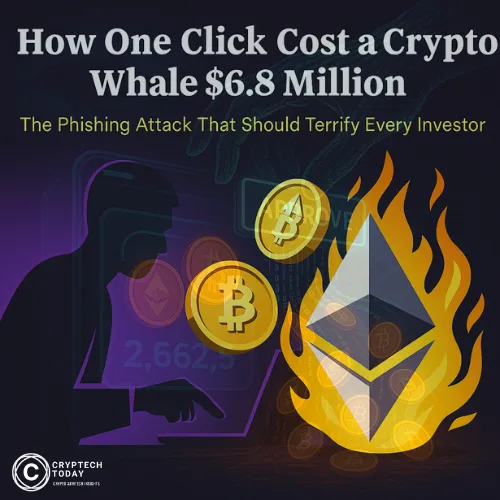
How One Click Cost a Crypto Whale $6.8 Million: The Phishing Attack That Should Terrify Every Investor

A single malicious signature wiped millions in ETH and BTC, exposing the growing threat of whale-targeted phishing schemes.

Pranav Joshi by Pranav Joshi
October 1, 2025
in Security & Risks
0
How One Click Cost a Crypto Whale $6.8 Million: The Phishing Attack That Should Terrify Every Investor
74
SHARES
1.2k
VIEWS
Share on FacebookShare on Twitter

In September 2025, a Crypto Whale lost $6.8 million in minutes after clicking what seemed like a routine link. The victim unknowingly signed “permit” requests that drained $4.3 million in staked Ethereum and $2.2 million in wrapped Bitcoin, all without a gas fee or warning from their wallet.

Table of Contents

Toggle
    • You might also like
    • Distillation Wars: When AI Models Compete by Copying Each Other
    • USD1 Depeg: Political Volatility Tests Stablecoin Stability
    • The Coin Laundry Files: Inside the Exchanges That Enabled a Global Laundering Machine
  • The Anatomy of a Million-Dollar Mistake
  • Whale Hunting: A Rising Industry
  • The Drainer-as-a-Service Economy
  • How Permit Phishing Works
  • Protecting Yourself: Defence Strategies
  • Author’s Thoughts

You might also like

Distillation Wars: When AI Models Compete by Copying Each Other

USD1 Depeg: Political Volatility Tests Stablecoin Stability

The Coin Laundry Files: Inside the Exchanges That Enabled a Global Laundering Machine

This attack reveals a harsh truth: in crypto, security doesn’t always fail on-chain; it fails in human trust. Phishing remains the most devastating threat, capable of wiping fortunes with a single careless click.

The Anatomy of a Million-Dollar Mistake

The September heist used Ethereum’s Permit signature feature, designed for convenience but now exploited for theft. Unlike standard transfers, these off-chain approvals cost no gas and look harmless. “From the victim’s perspective, he just clicked a few times, didn’t spend a penny of gas, and $6.28 million was gone,” explained Yu Xian, founder of SlowMist. Once signed, the attacker combined permit approvals with TransferFrom functions, draining assets in seconds. Funds were swiftly laundered across addresses and mixing tools, leaving almost no recovery chance.

Whale Hunting: A Rising Industry

This case is part of a chilling trend: whale-targeted phishing. In August 2025, over $163 million was stolen via phishing, a 15% rise from July. By September, global crypto hack losses had already crossed $2.5 billion.

Earlier cases highlight how attackers refine their techniques. In August 2024, a Crypto Whale lost $55 million in DAI after signing a malicious vault transfer. Just a month later, another fell victim to a $32 million wETH phishing scam. By October 2024, an attack drained $35 million in Few Wrapped Duo ETH, crashing the token’s value by 90%. Attackers carefully study Crypto Whale wallets, craft tailored lures, and exploit trust in familiar interfaces.

The Drainer-as-a-Service Economy

Behind these scams lies a thriving underground “crypto drainer” market. Tools like Inferno Drainer, once responsible for $70 million in thefts, have returned with even stronger features. These services operate almost like SaaS startups: they run subscription models, taking around 20% of stolen funds. They provide ready-made phishing kits, phishing templates, and hosting, while using anti-detection tactics such as one-time contracts and address rotation. Some even offer customer support, turning cybercrime into a professionalised service. By mid-2024, more than 40,000 drainer apps were in circulation, making phishing cheaper and more scalable than ever.

How Permit Phishing Works

Permit phishing is a type of crypto scam where hackers trick you into signing a special permission, called a permit signature. Normally, when you send tokens, you pay a small gas fee and see a clear confirmation. This extra step helps people realise if something looks wrong. But with permit phishing, the signature happens off-chain with no gas fee, so it feels harmless. In reality, it’s like signing a blank check: once you give it, the attacker can use that permission anytime to pull tokens out of your wallet without you clicking “approve” again.

This attack works because the permit signature lets the scammer use the transferFrom function. Instead of you sending tokens out, they can “pull” tokens directly from your wallet, quietly and repeatedly. Many users don’t notice until it’s too late, since no new on-chain approval is required after the signature. The risk is even higher with systems like Uniswap’s Permit2, where people often give unlimited allowances. If you gave that unlimited access in the past, your wallet may remain exposed until you manually revoke the permissions.

Protecting Yourself: Defence Strategies

For whales and everyday investors, the defence playbook is about slowing down and adding friction back into your process. Storing significant holdings in hardware wallets ensures that transactions require a physical confirmation, making it harder for remote attackers to drain funds. Equally important is to scrutinise signatures before clicking “approve”, a habit that could have prevented the $6.8 million loss. Instead of following embedded links, investors should manually navigate to the official site or dApp.

Another overlooked step is revoking token allowances. Unlimited approvals create a permanent vulnerability that hackers can exploit at any time, but using tools like Etherscan’s approval checker can minimise this risk. For added protection, enabling multi-factor authentication on crypto accounts and avoiding public WiFi for transactions are simple yet effective practices. Finally, investors should set up alerts for wallet activity, ensuring suspicious approvals or transfers are flagged immediately. Early detection may not stop theft, but it can limit the damage.

Author’s Thoughts

As I look at this case, what strikes me most is that blockchains themselves didn’t fail; people did. This is why phishing remains such a devastating weapon. A smart contract can be flawless, a wallet interface airtight, but the weakest point will always be the human on the other end of the screen.

The $6.8 million Crypto Whale phishing hack isn’t just a story about one careless click; it’s a warning that even the wealthiest, most experienced investors are just as vulnerable as newcomers. In Web3, convenience has become a double-edged sword, and until the industry finds ways to redesign how permissions work, personal vigilance is the only firewall that matters.

Share30Tweet19
Pranav Joshi

Pranav Joshi

A blockchain book author and crypto expert, dedicated to making cryptocurrency simple for everyone — byte by byte.

Recommended For You

Distillation Wars: When AI Models Compete by Copying Each Other

by Pranav Joshi
February 25, 2026
0

For years, large language models were trained on the open web. News articles, blogs, code repositories, academic papers, and creative writing were absorbed into vast training datasets. AI...

Read moreDetails

USD1 Depeg: Political Volatility Tests Stablecoin Stability

by Pranav Joshi
February 24, 2026
0

On February 23, 2026, USD1 — the dollar-pegged stablecoin issued by World Liberty Financial briefly slipped below its $1 benchmark, trading between $0.993 and $0.994 before recovering toward...

Read moreDetails

The Coin Laundry Files: Inside the Exchanges That Enabled a Global Laundering Machine

by Pranav Joshi
November 19, 2025
0
The Coin Laundry Files: Inside the Exchanges That Enabled a Global Laundering Machine

When the Coin Laundry investigation first surfaced through the International Consortium of Investigative Journalists, the public saw headlines about a Cambodian conglomerate called Huione Group. But what the...

Read moreDetails

The Coin Laundry: Inside the Global Crypto Laundering Machine Operating in Plain Sight

by Pranav Joshi
November 18, 2025
1
The Coin Laundry: Inside the Global Crypto Laundering Machine Operating in Plain Sight

For months, murmurs in the crypto community hinted at strange on-chain behaviour: unfamiliar wallets moving millions, sudden bursts of stablecoin transfers, and accounts on major exchanges receiving funds...

Read moreDetails

Tracing 127,271 BTC: On-Chain Forensics and Global Policy Lessons from the Prince Group Case

by Pranav Joshi
October 16, 2025
0
Tracing 127,271 BTC: On-Chain Forensics and Global Policy Lessons from the Prince Group Case

In October 2025, the U.S. Department of Justice (DOJ) filed a civil and criminal forfeiture action targeting 127,271 BTC worth nearly $15 billion from wallets allegedly controlled by...

Read moreDetails
Next Post
The Lazarus Laundering Operation: How North Korea’s $1.5 Billion Bybit Heist Rewrote the Rules of Digital Warfare

The Lazarus Laundering Operation: How North Korea’s $1.5 Billion Bybit Heist Rewrote the Rules of Digital Warfare

Related News

Graphic showing Bitcoin logos and financial charts, symbolizing crypto market movements.

Bhutan Transfers 519.7 Bitcoin Amid Rising State Wallet Outflows

March 25, 2026
Senator Tillis speaking at a podium during a Senate committee meeting on financial regulations.

Tillis Clears Way for Senate Vote on Warsh’s Fed Nomination

April 28, 2026
Cryptocurrency exchange logo with a backdrop of financial decline graphs and news headlines.

Over Foundation Shuts Down Over Protocol, Ending Its Services

April 29, 2026

Browse by Category

  • BlockBasics
  • Blockchain
  • Blockchain & Web3
  • Central Bank Digital Currency (CBDC)
  • Crypto
  • Crypto Now
  • Cryptocurrency
  • Ethereum
  • Finance
  • Fintech & Digital Finance
  • Geopolitics & Economy
  • GreenLedger
  • Inside CrypTechToday
  • Legal & Business Pages
  • Market Watch
  • People & Companies
  • Policy & Regulation
  • Politics
  • Security & Risks
  • Technology
  • World
cryptechtoday

CrypTechToday is a digital platform covering cryptocurrency, blockchain, and global finance, combined with practical tools for real-world crypto use.

  • About Us
  • Tools
  • Privacy Policy
  • Terms of Service
  • Disclosure
  • Cookie Policy
  • Disclaimer
  • Contact Us
  • Write for Us
  • Advertise
  • Tools
  • About
  • Contact

© 2025 CrypTechToday All rights reserved.

No Result
View All Result
  • News
    • Market Watch
    • Policy & Regulation
    • Geopolitics & Economy
    • Security & Risks
  • Blockchain & Web3
  • Finance & Fintech
    • Cryptocurrency
    • Fintech & Digital Finance
  • Voices
    • Events & Interviews
    • People & Companies

© 2025 CrypTechToday All rights reserved.

Are you sure want to unlock this post?
Unlock left : 0
Are you sure want to cancel subscription?