• Write for Us
  • Advertise
  • Tools
  • About
  • Contact
Cryptech Today
  • News
    • Market Watch
    • Policy & Regulation
    • Geopolitics & Economy
    • Security & Risks
  • Blockchain & Web3
  • Finance & Fintech
    • Cryptocurrency
    • Fintech & Digital Finance
  • Voices
    • Events & Interviews
    • People & Companies
No Result
View All Result
tokenomist ai
Cryptech Today
  • News
    • Market Watch
    • Policy & Regulation
    • Geopolitics & Economy
    • Security & Risks
  • Blockchain & Web3
  • Finance & Fintech
    • Cryptocurrency
    • Fintech & Digital Finance
  • Voices
    • Events & Interviews
    • People & Companies
No Result
View All Result
Cryptech Today
No Result
View All Result
Home Security & Risks

USD1 Depeg: Political Volatility Tests Stablecoin Stability

USD1 briefly depegged after a coordinated social media breach. Here’s how World Liberty Financial’s reserves and structure prevented systemic failure.

Pranav Joshi by Pranav Joshi
February 24, 2026
in Security & Risks
0
USD1 Depeg: Political Volatility Tests Stablecoin Stability
74
SHARES
1.2k
VIEWS
Share on FacebookShare on Twitter
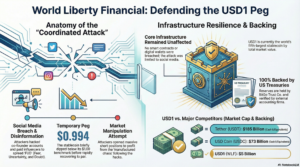
On February 23, 2026, USD1 — the dollar-pegged stablecoin issued by World Liberty Financial briefly slipped below its $1 benchmark, trading between $0.993 and $0.994 before recovering toward $0.9994 within hours.
Initial social media commentary exaggerated the scale of the decline. On-chain data later confirmed that the deviation was narrow and short-lived. No reserve imbalance was reported, and redemption functionality remained operational throughout the event.
From a market-structure perspective, the episode did not resemble a systemic collapse. Instead, it reflected how quickly stablecoin confidence can be tested when political narratives intersect with digital liquidity.
The incident was less about infrastructure failure and more about perception shock.

WLFI or USD1 smart contracts or wallets were hacked

Table of Contents

Toggle
    • You might also like
    • Distillation Wars: When AI Models Compete by Copying Each Other
    • The Coin Laundry Files: Inside the Exchanges That Enabled a Global Laundering Machine
    • The Coin Laundry: Inside the Global Crypto Laundering Machine Operating in Plain Sight
  • The Social Layer Attack: How Narrative Became the Weapon
  • Liquidity Concentration and Structural Stability
  • Infrastructure Integrity: What Did Not Break
  • The Political Overlay: A Different Risk Profile
  • Economic Incentives and Strategic Transparency
  • What This Means for Stablecoin Markets

You might also like

Distillation Wars: When AI Models Compete by Copying Each Other

The Coin Laundry Files: Inside the Exchanges That Enabled a Global Laundering Machine

The Coin Laundry: Inside the Global Crypto Laundering Machine Operating in Plain Sight

The Social Layer Attack: How Narrative Became the Weapon

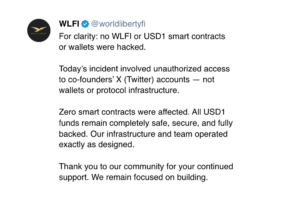
According to statements released by World Liberty Financial, the volatility followed a coordinated social media breach. Multiple X (formerly Twitter) accounts linked to project affiliates were compromised and used to circulate misleading information.
The disruption followed three visible stages:
  1. Account Compromise – Unauthorised access to public-facing accounts associated with individuals connected to the project.
  2. Amplified Disinformation – Rapid spread of uncertainty across influencer networks.
  3. Volatility Exploitation – Short positioning allegedly opened during the panic window.
No smart contracts were exploited. No treasury wallets were drained. No redemption halt occurred.
This distinction is critical.
The attack targeted the social layer of crypto markets, not the protocol layer.
And in modern digital finance, narrative velocity can move prices faster than technical fundamentals.

Liquidity Concentration and Structural Stability

On-chain analytics platform Arkham indicated that a significant portion of USD1’s circulating supply, approximately $4.5 billion of its $5 billion market capitalisation, is held on Binance.
This liquidity concentration may have contributed to price stabilisation. When large custodial balances remain stationary, volatility events driven by retail panic are less likely to cascade into systemic selloffs.
The structure created an unintended defence mechanism:
Retail-driven narrative shock met institutional-scale liquidity inertia.
That containment limited the duration and depth of the de-peg.

Infrastructure Integrity: What Did Not Break

World Liberty Financial stated that:
  • No smart contracts were altered.
  • No reserve wallets were accessed.
  • Issuance and redemption mechanisms functioned normally.
  • Custodial reserves remained intact.
USD1 operates under a 1:1 backing model reportedly composed of U.S. dollars, short-term U.S. Treasuries, and cash equivalents.
Reserves are issued and custodied via BitGo Trust Company, with monthly attestation reports reviewed by Crowe LLP under AICPA standards.
From an operational standpoint, the infrastructure held.
The volatility originated outside the balance sheet.

The Political Overlay: A Different Risk Profile

USD1 is not a neutral financial instrument in the traditional sense. The project’s association with members of the Trump family, including Donald Trump, positions it uniquely within the geopolitical and regulatory landscape.
That connection creates what analysts would call a political beta factor:
  • Higher media sensitivity
  • Faster narrative amplification
  • Elevated regulatory attention
  • Increased probability of targeted attacks
When stablecoins intersect with political influence, they inherit both visibility and vulnerability.
This does not automatically imply structural weakness. But it does introduce volatility vectors not typically present in conventional digital dollar models.
WLFI or USD1 smart contracts or wallets were hacked

Economic Incentives and Strategic Transparency

At a $5 billion market capitalisation, reserve yields matter.
Assuming short-term U.S. Treasury yields near 3%, such a structure could generate approximately $150 million annually in gross yield revenue. That creates strong incentive alignment around reserve protection and credibility maintenance.
World Liberty Financial has positioned “radical transparency” as its strategic defence:
  • 1:1 reserve disclosure model
  • Monthly attestations
  • Regulated custodial framework
  • Treasury-backed asset composition
In politically sensitive projects, transparency becomes more than compliance; it becomes a stability tool.

What This Means for Stablecoin Markets

The February 23 episode illustrates a broader evolution in crypto risk:
Phase 1 risk was smart contract failure.
lass=”yoast-text-mark” />>Phase 2 risk was custodial insolvency.
>Phase 3 risk is narrative manipulation.
Stablecoins are no longer destabilised only by liquidity imbalances. They can be pressured by coordinated sentiment attacks, especially when political capital is involved.
USD1’s recovery suggests that reserve-backed architecture can withstand short-term perception shocks.
But the event reinforces a structural truth:
In 2026, digital assets operate at the intersection of code, capital, and politics.
The “Siege of USD1” was not a liquidity crisis. It was a stress test of narrative resilience. The blockchain held.
The reserves remained intact. The peg recovered. But the broader lesson is clear: politically exposed crypto ventures operate under amplified scrutiny and asymmetric attack risk.
In an era where disinformation can move markets in minutes, institutional-grade custody and transparent reserves are necessary but not sufficient. Stability now depends on defending both the protocol layer and the perception layer. And that is the new frontier of digital finance.

Tags: Crypto Market Manipulationcrypto market volatilitydigital-asset-securityPolitical Risk in CryptoStablecoin DepegStablecoin RegulationStablecoin TransparencyUS Treasury Backed StablecoinsUSD1World Liberty Financial
Share30Tweet19
Pranav Joshi

Pranav Joshi

A blockchain book author and crypto expert, dedicated to making cryptocurrency simple for everyone — byte by byte.

Recommended For You

Distillation Wars: When AI Models Compete by Copying Each Other

by Pranav Joshi
February 25, 2026
0
Distillation Wars: When AI Models Compete by Copying Each Other

For years, large language models were trained on the open web. News articles, blogs, code repositories, academic papers, and creative writing were absorbed into vast training datasets. AI...

Read moreDetails

The Coin Laundry Files: Inside the Exchanges That Enabled a Global Laundering Machine

by Pranav Joshi
November 19, 2025
0
The Coin Laundry Files: Inside the Exchanges That Enabled a Global Laundering Machine

When the Coin Laundry investigation first surfaced through the International Consortium of Investigative Journalists, the public saw headlines about a Cambodian conglomerate called Huione Group. But what the...

Read moreDetails

The Coin Laundry: Inside the Global Crypto Laundering Machine Operating in Plain Sight

by Pranav Joshi
November 18, 2025
1
The Coin Laundry: Inside the Global Crypto Laundering Machine Operating in Plain Sight

For months, murmurs in the crypto community hinted at strange on-chain behaviour: unfamiliar wallets moving millions, sudden bursts of stablecoin transfers, and accounts on major exchanges receiving funds...

Read moreDetails

Tracing 127,271 BTC: On-Chain Forensics and Global Policy Lessons from the Prince Group Case

by Pranav Joshi
October 16, 2025
0
Tracing 127,271 BTC: On-Chain Forensics and Global Policy Lessons from the Prince Group Case

In October 2025, the U.S. Department of Justice (DOJ) filed a civil and criminal forfeiture action targeting 127,271 BTC worth nearly $15 billion from wallets allegedly controlled by...

Read moreDetails

Inside the Prince Group Crypto Scam: How the U.S. Unravelled a $15 Billion Bitcoin Empire

by Pranav Joshi
October 16, 2025
0
Inside the Prince Group Crypto Scam: How the U.S. Unravelled a $15 Billion Bitcoin Empire

On October 14, 2025, the United States Department of Justice (DOJ) filed the largest cryptocurrency forfeiture action in history, seeking permanent seizure of 127,271 Bitcoin valued at $15...

Read moreDetails
Next Post
Data charts and graphs analyzing cryptocurrency trends and insider trading implications.

ZachXBT Prepares Crypto Exposé Amid Insider Trading Allegations

Related News

XRP coin on a digital trading screen with fluctuating market charts and liquidation alerts.

XRP Drops to $2.12 Amid Liquidations and Market Volatility

January 9, 2026
Email correspondence on financial investments and crypto regulations in Epstein's case.

DOJ Emails Reveal Jeffrey Epstein’s $3.2 Million Coinbase Investment

February 3, 2026
Wikimedia representatives shaking hands with AI executives at a partnership announcement event.

Wikimedia Foundation Partners With AI Giants for Content Licensing

January 16, 2026

Browse by Category

  • BlockBasics
  • Blockchain
  • Blockchain & Web3
  • Central Bank Digital Currency (CBDC)
  • Crypto
  • Crypto Now
  • Cryptocurrency
  • Ethereum
  • Finance
  • Fintech & Digital Finance
  • Geopolitics & Economy
  • GreenLedger
  • Inside CrypTechToday
  • Legal & Business Pages
  • Market Watch
  • People & Companies
  • Policy & Regulation
  • Politics
  • Security & Risks
  • Technology
  • World
cryptechtoday

CrypTechToday is a digital platform covering cryptocurrency, blockchain, and global finance, combined with practical tools for real-world crypto use.

  • About Us
  • Tools
  • Privacy Policy
  • Terms of Service
  • Disclosure
  • Cookie Policy
  • Disclaimer
  • Contact Us
  • Write for Us
  • Advertise
  • Tools
  • About
  • Contact

© 2025 CrypTechToday All rights reserved.

No Result
View All Result
  • News
    • Market Watch
    • Policy & Regulation
    • Geopolitics & Economy
    • Security & Risks
  • Blockchain & Web3
  • Finance & Fintech
    • Cryptocurrency
    • Fintech & Digital Finance
  • Voices
    • Events & Interviews
    • People & Companies

© 2025 CrypTechToday All rights reserved.

Are you sure want to unlock this post?
Unlock left : 0
Are you sure want to cancel subscription?