• Write for Us
  • Advertise
  • Tools
  • About
  • Contact
Cryptech Today
  • News
    • Market Watch
    • Policy & Regulation
    • Geopolitics & Economy
    • Security & Risks
  • Blockchain & Web3
  • Finance & Fintech
    • Cryptocurrency
    • Fintech & Digital Finance
  • Voices
    • Events & Interviews
    • People & Companies
No Result
View All Result
tokenomist ai
Cryptech Today
  • News
    • Market Watch
    • Policy & Regulation
    • Geopolitics & Economy
    • Security & Risks
  • Blockchain & Web3
  • Finance & Fintech
    • Cryptocurrency
    • Fintech & Digital Finance
  • Voices
    • Events & Interviews
    • People & Companies
No Result
View All Result
Cryptech Today
No Result
View All Result
Home Fintech & Digital Finance

Meta’s Bitcoin treasury proposal rejection is a revelation

Nearly 99.9% of Meta's shareholders decided against the move, showing that not all of Wall Street's strategies are welcome among corporates

Pranav Joshi by Pranav Joshi
June 27, 2025
in Fintech & Digital Finance, GreenLedger
0
Meta’s Bitcoin treasury proposal rejection is a revelation
74
SHARES
1.2k
VIEWS
Share on FacebookShare on Twitter

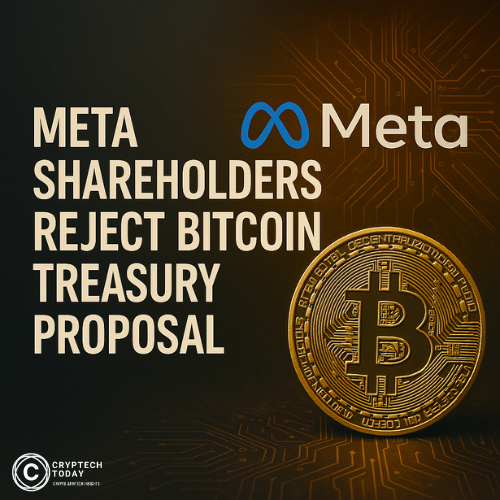
In a near-unanimous decision, Meta shareholders voted down a proposal to include Bitcoin in the company’s corporate treasury. Over 98% of investors opposed the motion.

Table of Contents

Toggle
  • You might also like
  • The Illusion of Military AI: How Overdependence on Algorithms Could Manipulate Modern Warfare
  • Anthropic Banned, OpenAI Steps In: Pentagon’s AI Power Shift
  • The AI Spy War: How Israel Watched Tehran for Years
  • Is Meta’s a strategic refusal or conservative hesitation?
  • A stark contrast with corporate crypto enthusiasts
  • The influence of institutional investors and ESG mandates
  • What Meta’s decision means for Bitcoin’s corporate future

You might also like

The Illusion of Military AI: How Overdependence on Algorithms Could Manipulate Modern Warfare

Anthropic Banned, OpenAI Steps In: Pentagon’s AI Power Shift

The AI Spy War: How Israel Watched Tehran for Years

This stark rejection, at a time when traditional institutions are increasingly warming to digital assets, also raises a deeper question. Why is one of the world’s largest tech conglomerates resisting an asset that many institutional investors are slowly embracing?

The proposal was brought forth by shareholder and Bitcoin advocate Mark Cochran, who argued that Bitcoin could serve as a strategic hedge against inflation and economic instability. He cited examples of corporations such as MicroStrategy, Tesla, and Block, which have integrated Bitcoin into their balance sheets with the aim of diversification and long-term asset preservation. Yet Meta’s board, and clearly its investors, were unmoved.

According to Meta’s proxy statement filed with the SEC, the board not only rejected the proposal but also recommended that shareholders vote against it, asserting that such a move “would not be in the best interests of the company or its shareholders.” The proposal was thus shut down with 98% opposition, leaving only a fringe minority in support—effectively a 99.9% symbolic rejection if abstentions are considered.

Is Meta’s a strategic refusal or conservative hesitation?

To understand the implications of this rejection, it is crucial to analyze Meta’s broader strategic goals. The company has pivoted hard toward AI innovation and immersive technology, especially since rebranding from Facebook to Meta in 2021. Its investment in the metaverse has consumed billions of dollars annually, and its Reality Labs division posted multi-billion-dollar losses in recent years.

Adding Bitcoin to the balance sheet could be seen as diverting focus or introducing volatility to an already complex financial picture. The board of Meta contended that owning Bitcoin might present “unnecessary risks” and divert attention from the company’s strategic objective.  Given that Bitcoin’s price fluctuated by over 60% in a single year as recently as 2022, the risk aversion isn’t entirely unfounded.

Moreover, Meta is a high-profile target for regulatory scrutiny. Its foray into digital currency via the Libra (later Diem) project was met with stiff opposition from lawmakers and was eventually abandoned. The company may be hesitant to re-enter crypto territory in any capacity, even indirectly, fearing renewed regulatory pressure.

A stark contrast with corporate crypto enthusiasts

Despite Meta’s stance, a growing list of corporations has been adding Bitcoin to their treasuries, albeit cautiously. MicroStrategy remains the torchbearer, now holding over 214,000 BTC valued at approximately $14 billion. Tesla made headlines in 2021 when it bought $1.5 billion worth of Bitcoin, although it later sold a significant portion. Bitcoin’s potential is still being promoted by payment company Block (previously Square), which also has a small amount of cryptocurrency in its treasury.

These moves, however, are not without controversy. Critics argue that Bitcoin holdings introduce unnecessary volatility, affect earnings reports, and could hurt shareholder value during market downturns. MicroStrategy, for example, reported paper losses in 2022 as Bitcoin prices plunged, affecting its stock valuation despite no realized losses.

Meta’s shareholders appear to have sided with this more conservative view. Unlike Block or MicroStrategy, Meta is not led by a Bitcoin maximalist CEO like Michael Saylor or Jack Dorsey. While blockchain first piqued Mark Zuckerberg’s interest (he named his pet goat Bitcoin), he has since turned his attention to AI infrastructure and product integration.  His company’s leadership doesn’t see Bitcoin as aligning with Meta’s business roadmap, and the shareholder vote reaffirms this posture.

The influence of institutional investors and ESG mandates

Another dimension to this rejection is the makeup of Meta’s shareholder base. Institutional investors such as Vanguard, BlackRock, and Fidelity own sizable stakes in Meta. These firms often prioritize ESG (Environmental, Social, and Governance) considerations, and Bitcoin has been a contentious topic in ESG circles due to concerns over its energy consumption.

BlackRock, while launching a successful Bitcoin ETF in 2024, has done so in a way that fits within a financial product offering, rather than on its own balance sheet. With the exception of Tesla’s brief involvement, none of the big S&P 500 firms have made substantial direct investments in Bitcoin. The rejection at Meta may reflect the broader institutional discomfort with Bitcoin as a corporate asset, even if they support it as an investable product.

This creates a nuanced paradox: the very institutions offering Bitcoin ETFs or advising on crypto exposure are simultaneously unwilling to endorse its inclusion in the companies they invest in. This suggests a bifurcation in strategy—Bitcoin is fine for portfolios, not balance sheets.

What Meta’s decision means for Bitcoin’s corporate future

The overwhelming disapproval at Meta doesn’t necessarily spell doom for corporate adoption of Bitcoin, but it does illuminate the uphill battle it faces. Bitcoin evangelists often assume that wider adoption is inevitable. Yet, when push comes to shove, conservative financial management and shareholder risk aversion seem to dominate boardroom decisions.

Meta’s rejection sends a clear signal to the market: Bitcoin, for now, remains outside the purview of mainstream corporate treasury practices. While startups and mid-cap companies might experiment with crypto holdings, Big Tech is not ready to take that leap.

At the same time, Meta’s decision may also be a reflection of timing rather than principle. With U.S. regulatory policy still ambiguous and economic uncertainty driving cautious spending, even bold companies are treading carefully. The real test may come when Bitcoin sees another major bull cycle or if regulatory clarity improves.

For now, however, the message from Meta’s boardroom is unambiguous—Bitcoin has no place on its books.


 

Share30Tweet19
Pranav Joshi

Pranav Joshi

A blockchain book author and crypto expert, dedicated to making cryptocurrency simple for everyone — byte by byte.

Recommended For You

The Illusion of Military AI: How Overdependence on Algorithms Could Manipulate Modern Warfare

by Pranav Joshi
March 10, 2026
0
The Illusion of Military AI: How Overdependence on Algorithms Could Manipulate Modern Warfare

Artificial intelligence is no longer a futuristic concept in warfare. It already helps militaries process satellite images, monitor borders, analyse communications, and prioritise potential targets. But a deeper...

Read moreDetails

Anthropic Banned, OpenAI Steps In: Pentagon’s AI Power Shift

by Pranav Joshi
March 4, 2026
0
Anthropic Banned, OpenAI Steps In: Pentagon's AI Power Shift

On February 27, 2026—one day before the first missiles struck Tehran—President Donald Trump signed an order banning all federal agencies from using technology developed by Anthropic. At the...

Read moreDetails

The AI Spy War: How Israel Watched Tehran for Years

by Pranav Joshi
March 3, 2026
0
The AI Spy War: How Israel Watched Tehran for Years

The bombs that fell on Tehran on February 28, 2026, did not arrive without warning, at least, not for the people who planned them. By the time the...

Read moreDetails

Coinbase’s vision: bringing the entire startup lifecycle on-chain

by Pranav Joshi
October 27, 2025
0
Visual pipeline showing a startup lifecycle on blockchain rails with Coinbase/Base logo. Caption: Coinbase aims to host the entire startup lifecycle onchain — from incorporation and fundraising to tokenized IPOs

Coinbase’s latest moves make one thing obvious: the company is no longer satisfied with being “just” an exchange. By acquiring on-chain fundraising platform Echo, doubling down on its...

Read moreDetails

SoftBank’s PayPay Acquires 40% Stake in Binance Japan to Expand Digital Payment Ecosystem

by Pranav Joshi
October 13, 2025
0
PayPay ’s 40% stake in Binance Japan pairs Japan’s leading cashless wallet with a global crypto exchange, aiming to make crypto easier for millions of users.

SoftBank-backed PayPay’s acquisition of a 40% equity stake in Binance Japan is a clear signal that Japan’s cashless-payments world is moving closer to cryptocurrency markets. Announced on October...

Read moreDetails
Next Post
The Next Wave of Crypto Threats 2025

Learning to face the next wave of crypto threats in 2025

Related News

Federal Reserve building with financial graphs overlay symbolizing interest rates and inflation.

Federal Reserve Keeps Interest Rates Steady Amid Inflation Concerns

March 19, 2026
Graphic illustrating the EURAU Euro stablecoin on the Solana blockchain with digital currency icons.

AllUnity Launches EURAU Euro Stablecoin on Solana Blockchain

April 30, 2026
Fellowship PAC representatives at a press conference discussing Texas Senate election funding.

Fellowship PAC Invests $1.75 Million in Texas Senate Election

April 24, 2026

Browse by Category

  • BlockBasics
  • Blockchain
  • Blockchain & Web3
  • Central Bank Digital Currency (CBDC)
  • Crypto
  • Crypto Now
  • Cryptocurrency
  • Ethereum
  • Finance
  • Fintech & Digital Finance
  • Geopolitics & Economy
  • GreenLedger
  • Inside CrypTechToday
  • Legal & Business Pages
  • Market Watch
  • People & Companies
  • Policy & Regulation
  • Politics
  • Security & Risks
  • Technology
  • World
cryptechtoday

CrypTechToday is a digital platform covering cryptocurrency, blockchain, and global finance, combined with practical tools for real-world crypto use.

  • About Us
  • Tools
  • Privacy Policy
  • Terms of Service
  • Disclosure
  • Cookie Policy
  • Disclaimer
  • Contact Us
  • Write for Us
  • Advertise
  • Tools
  • About
  • Contact

© 2025 CrypTechToday All rights reserved.

No Result
View All Result
  • News
    • Market Watch
    • Policy & Regulation
    • Geopolitics & Economy
    • Security & Risks
  • Blockchain & Web3
  • Finance & Fintech
    • Cryptocurrency
    • Fintech & Digital Finance
  • Voices
    • Events & Interviews
    • People & Companies

© 2025 CrypTechToday All rights reserved.

Are you sure want to unlock this post?
Unlock left : 0
Are you sure want to cancel subscription?